
Table of Contents
- How Tree Roots Get Into Your Pipes in the First Place
- 7 Warning Signs of Tree Roots in Pipes
- How a CCTV Drain Inspection Confirms Root Intrusion
- Trenchless Root Removal vs Excavation: Which Fixes the Problem?
- Preventing Tree Roots in Sewer Pipes Before They Return
- Which Trees and Pipes Carry the Highest Risk
- What It Costs to Ignore Root Damage (And Who Pays)
- When to Call a Professional for Root Blockage
- Frequently Asked Questions
Last Updated: September 14, 2026
How Tree Roots Get Into Your Pipes in the First Place
Tree roots invade sewer lines through the smallest imperfections: hairline cracks, loose pipe joints, and condensation around buried plumbing. A root hair enters a gap narrower than a human hair, then branches into a mat that catches everything flowing past it.
A sewer lateral carries warm water and nutrients; vapour escaping a cracked joint condenses on cooler soil, and roots growing toward moisture find that joint precisely.
Older earthenware and concrete pipes are most vulnerable: their joints shift as soil settles, opening gaps a modern PVC line would never develop. Once inside, roots widen the crack.
This is why “signs of tree roots in pipes” almost always trace back to three conditions: ageing pipework, mature trees within a few metres of the line, and soil that stays damp year-round.
7 Warning Signs of Tree Roots in Pipes
The clearest early warning is a drain that misbehaves in a pattern rather than at random. Root intrusion develops slowly, so symptoms build in sequence: sound, then flow, then smell, then ground movement.
Watch for these seven signs, in roughly the order they appear:
- Gurgling noises from toilets or floor wastes after you run a tap
- Slow-draining fixtures that clear themselves, then slow again
- Repeated blockages at the same fixture within weeks
- Sewage odours indoors or around the yard
- Patches of unusually lush vegetation above the line
- Sinkholes or sunken ground along the pipe route
- Multiple fixtures backing up simultaneously
One symptom proves nothing; two or more together, especially after a dry spell, point strongly toward root intrusion.
Chemical drain cleaner on a root blockage buys you days, not a fix. The root survives, the blockage returns, and the caustic residue can damage older pipe joints and leave a hazard for the plumber who inspects it later.
1. Gurgling Noises From Drains
Gurgling means air is being pulled through water somewhere it shouldn’t be. A root mass narrows the pipe, wastewater backs up behind it, and trapped air escapes through the nearest fixture trap. If gurgling follows one fixture every time, the blockage sits downstream of it.
2. Slow-Draining Fixtures and Repeated Blockages
A fixture that drains slowly, clears after a plunger or snake, then slows again within a fortnight is the classic root signature. Manual clearing punches a hole through the root mat; the root keeps growing and the hole closes. Repeated blockages at one point are the most reliable indicator of something structural.
3. Sewage Odours and Patches of Lush Vegetation
Sewage odours indoors suggest a breach in the line beneath or near the building. Outside, look for a strip of grass greener than everything around it, or a shrub that outgrows its neighbours. That patch is fed by wastewater escaping a cracked pipe, and roots are there to collect it.
4. Sinkholes, Sunken Ground and Moisture Accumulation
Ground that dips above the sewer route, or soil that stays soft and damp when the rest of the yard is dry, signals sustained leakage. A sinkhole is the late stage: soil washed into the broken pipe leaves a void beneath the surface. Treat any depression over a sewer line as urgent.
How a CCTV Drain Inspection Confirms Root Intrusion
A CCTV drain inspection is the only reliable way to confirm root intrusion, because it shows the inside of the pipe directly rather than inferring from symptoms. A camera on a flexible reel records root masses, cracked joints, displaced pipe, and the exact distance from the access point.
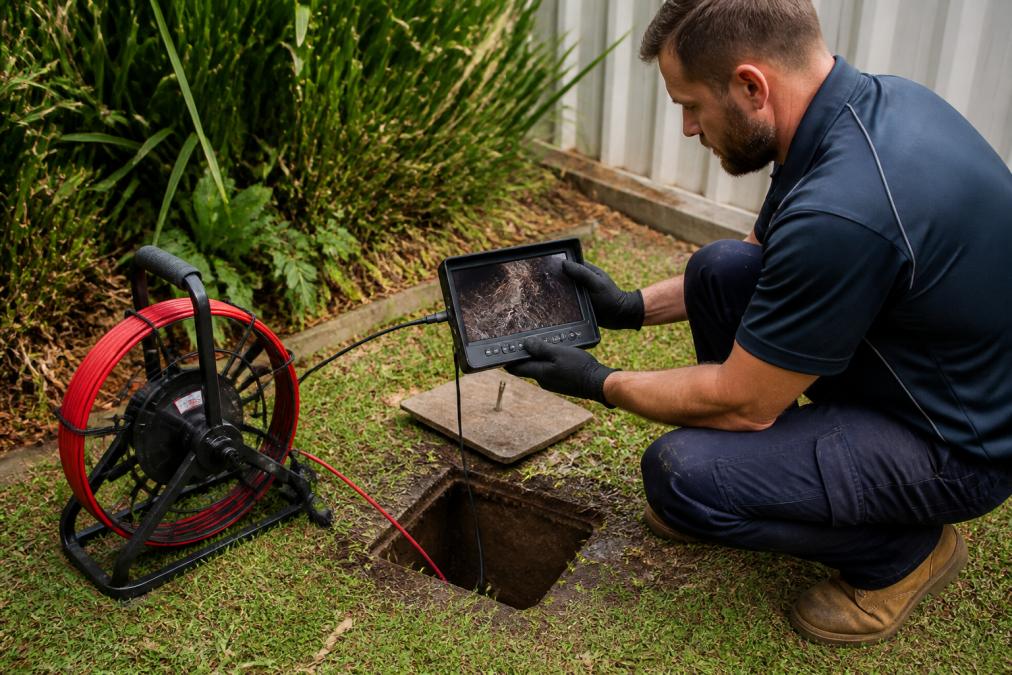
The footage answers the questions that decide your repair: how far along the line the problem sits, how much of the pipe circumference is affected, and whether the pipe is still structurally sound. It also gives you a record to compare against after any repair.
At Drains Plus, every job includes a complimentary plumbing health check, so the camera work covers the whole line rather than just the blockage, roots rarely invade at only one point.
Trenchless Root Removal vs Excavation: Which Fixes the Problem?
Trenchless root removal vs excavation comes down to one question: is the pipe itself still intact? If the pipe is sound and only obstructed, trenchless methods cut and clear the roots without disturbing your yard. If it has collapsed or lost structural integrity, excavation and replacement is the honest answer.
| Situation | Recommended Method | Why |
|---|---|---|
| Roots present, pipe intact | Hydro-jetting plus cutting head | Clears root mass, no digging |
| Roots plus cracked joints | Trenchless repair or relining | Seals the entry point roots used |
| Localised collapse | Targeted excavation | Relining needs a sound host pipe |
| Severe root mat, repeated returns | CCTV first, then method chosen | Footage decides, not guesswork |
Hydro-jetting uses high-pressure water to scour the pipe wall, and a cutting attachment slices through root mass rather than punching a hole through it. Trenchless repair then seals the defect so roots have nothing to re-enter. Excavation is the right call when the pipe has genuinely failed, no amount of relining fixes a collapsed section.
The mistake homeowners make is accepting a quote for excavation before anyone has seen the inside of the pipe. A CSIRO urban water infrastructure research perspective on pipe condition makes the point plainly: repair decisions should follow inspection, not precede it.
Ask for the CCTV footage itself, not just a verbal summary. A recording with distance markers lets you get a second opinion on the same evidence, which is difficult when all you have is a description.
Preventing Tree Roots in Sewer Pipes Before They Return
Prevention is not one action but a layered strategy. Roots exploit defects, so the durable fix is sealing defects; everything else is management. A practical plan works on four fronts: the pipe, the soil, the planting, and the inspection schedule.
1. Fix the pipe before you fix the garden.
A sound, well-jointed pipe resists roots almost indefinitely. If your line has been cleared twice in a year, the pipe needs sealing, not another round of clearing. Relining or spot-repairing cracked joints removes the entry point entirely, the only permanent answer. Root-killer products slow regrowth but do not repair the defect, and repeated caustic dosing can degrade older jointing compounds.
2. Manage soil moisture around the line.
Roots grow toward moisture, so a leaking pipe is an open invitation. Two habits reduce the draw:
- Water deeply and less often rather than lightly and frequently, so surface moisture does not pool near the sewer route.
- Fix dripping taps, irrigation leaks and stormwater overflows promptly. A slow leak saturating the soil above a lateral is the most common precursor to intrusion.
3. Plant with the pipe in mind.
When planting near a sewer lateral, assume the canopy mirrors the root spread: a tree whose canopy will span eight metres is likely to send roots at least that far in search of water. Keep new plantings well clear of the line, and prefer species with non-aggressive, fibrous roots over those known to seek water hard.
4. Install a root barrier where planting is unavoidable.
Physical root barriers are rigid panels installed vertically between the tree and the pipe, typically to a depth of at least 600 mm and extending above the surface to stop roots climbing over. They work best installed at planting time; retrofitting around an established tree means cutting roots, which stresses it and can trigger a surge of regrowth. A qualified arborist or landscaper should specify depth and length for your soil type and species.
5. Schedule inspection rather than waiting for symptoms.
A CCTV check every two to three years on a mature line, or annually where a high-risk species sits within a few metres, catches intrusion while it is still a clearing job rather than a replacement. Put it in the same calendar slot as your smoke-alarm check so it actually happens.
If you are buying a property with mature trees near the boundary, ask for the sewer diagram and a recent CCTV report before settlement. A pre-purchase camera inspection is far cheaper than discovering a root-choked lateral after you move in.
Which Trees and Pipes Carry the Highest Risk
Risk comes from the combination of species and pipe material, not from trees alone. Some species send aggressive roots toward moisture; others behave well near buried services.
High-risk species include willows, figs, poplars, and liquidambars, all of which seek water aggressively and tolerate damp soil. Eucalypts and most native gums are lower risk, though mature specimens near a leaking line will still find it. The real variable is distance: a tree within a few metres of a sewer lateral carries far more risk than the same species across the yard.
On the pipe side, earthenware, concrete, and older clay lines are most vulnerable because their joints open as ground moves. PVC and modern jointed pipe resist root entry far better, which is why relining an old line often solves the problem permanently.
The tree is rarely the whole story. A sound, well-jointed pipe resists roots almost indefinitely. Roots are a symptom of a pipe defect, and the defect is what needs fixing.
What It Costs to Ignore Root Damage (And Who Pays)
Ignoring root damage moves the problem from a drain clearing to a pipe replacement, and the cost gap is wide. A blocked line cleared early is a maintenance job; a collapsed line under a driveway or slab means excavation, reinstatement, and possibly a claim. The longer you wait, the more of the pipe the roots occupy and the more of the yard they disturb.
Who is responsible for which section
Responsibility generally splits at the connection point between your private sewer lateral and the utility’s main. The property owner is usually responsible for the lateral on their side, including any section under the driveway, garden or slab; the water authority handles the main. Because the exact boundary varies by state and title, the authoritative source is your water authority’s sewer diagram, which you can request directly. Do not rely on a neighbour’s assumption or a plumber’s verbal summary.
When a neighbour’s tree is the cause
If a tree on an adjoining property has invaded your line, liability can be shared, and the outcome often depends on whether the neighbour knew or ought to have known the tree was a risk. Most disputes are resolved by negotiation or, failing that, through your state’s civil and administrative tribunal rather than a court. Document everything: dated photographs, CCTV footage with distance markers, and written correspondence. Evidence gathered early makes a shared-cost outcome achievable.
What home insurance typically does and does not cover
Most home building policies treat gradual root intrusion as a maintenance matter rather than an insured event, because the damage accumulates over time rather than occurring suddenly (afca.org.au). The clearing and repair cost usually sits with you. Cover may respond where root intrusion causes a sudden, identifiable event, such as a collapsed section that damages a foundation or retaining wall. Policy wording varies significantly between insurers, so read the exclusions section of your Product Disclosure Statement before assuming cover, and ask your insurer directly whether root-related sewer damage is excluded.
If a claim is refused and you believe the decision is unfair, escalate to the insurer’s internal dispute resolution team and then to the Australian Financial Complaints Authority (AFCA), which provides free, independent dispute resolution for financial complaints (afca.org.au). For disputes about a tradesperson rather than an insurer, your state’s consumer affairs or fair trading body is the first contact.
The cost-benefit of acting early
The cheapest outcome is early detection. A CCTV inspection costs a fraction of excavation and reinstatement, and it tells you whether you face a clearing job or a repair job before you commit to either. Where the pipe is sound, hydro-jetting with a cutting head clears the root mass without digging. Where it is cracked, trenchless relining seals the entry point and is typically less disruptive and less expensive than open excavation. The decision should follow the footage, not precede it.
Root damage is rarely covered as a sudden event, so the financial case for prevention is stronger than the case for insurance. Inspect on a schedule, seal defects early, and keep the evidence if a neighbour’s tree is involved.
When to Call a Professional for Root Blockage
Call a professional when two or more fixtures back up at once, when sewage odours appear indoors, when you see a sinkhole over the line, or when the same drain blocks twice in a season. Guessing costs more than diagnosing.
Drains Plus has cleared more than 20,000 drains over 25 years, with 24/7 availability for blockages that will not wait until morning. Every job carries a no-clear, no-fee guarantee: if the drain cannot be cleared, you pay nothing. Our team works non-invasively wherever the pipe allows, and every job includes a free plumbing health check so you know the true condition of the line, not just the blockage.
If you have seen the signs of tree roots in pipes, the next step is a camera, not a shovel. Call Drains Plus and get the line inspected before you commit to any repair.
Root intrusion never resolves on its own, and the signs you noticed this week will be a collapsed line within a season or two. Drains Plus can confirm the problem with CCTV diagnostics, clear it non-invasively with hydro-jetting, and seal the entry point so roots do not return. With 24/7 availability, a no-clear, no-fee guarantee, and a free plumbing health check on every job, the diagnosis costs you nothing if we cannot clear it. Get started with Drains Plus and restore proper flow to your drainage system.
Frequently Asked Questions
What are the early warning signs of tree roots in sewer pipes?
The earliest signs are gurgling noises from toilets and drains, water draining slowly in multiple fixtures at once, and a recurring blockage in the same spot even after snaking. As roots grow, you may notice sewage odours near the garden, unusually lush patches of vegetation above the sewer line, or damp, sunken ground. If two or more of these appear together, book a CCTV drain inspection rather than reaching for another bottle of drain cleaner.
What dissolves tree roots in pipes?
Chemical root killers containing copper sulfate or foaming agents can slow root growth, but they rarely clear a mature blockage and can damage older pipe joints or harm soil and plants. They work best as a short-term measure between professional visits, not as a fix. Mechanical removal, followed by a CCTV drain inspection to check pipe integrity, is the reliable way to clear roots and confirm nothing structural has failed.
What is the difference between trenchless root removal and excavation?
Trenchless root removal clears or relines the pipe through existing access points, so lawns, driveways and paving stay intact. Excavation involves digging down to expose and replace the damaged section, which suits collapsed or badly cracked pipes. A CCTV drain inspection tells you which approach the damage actually requires, since many root blockages can be resolved without digging up the yard.
How do you stop tree roots from damaging pipes?
Preventing tree roots in sewer pipes comes down to three habits: know where your sewer lateral runs before planting anything, choose low-risk species and keep large trees well away from the line, and schedule periodic CCTV checks so small root intrusions are caught early. Replacing failing clay or cracked joints with sealed PVC also removes the entry points roots exploit. Older properties with established gardens benefit most from an annual inspection.