
Table of Contents
- Who Pays for Blocked Drains in Strata?
- Signs Your Commercial Property Needs Drain Cleaning
- Building a Strata Plumbing Maintenance Schedule
- Preventative Drain Maintenance That Actually Works
- Emergency Response and Legal Requirements for Strata Plumbing
- Long-Term Asset Management and Insurance Documentation
- Conclusion
- Frequently Asked Questions
Last Updated: September 13, 2026
Who Pays for Blocked Drains in Strata?
Working out who pays for blocked drains in strata comes down to one question: is the blockage on common property or inside a private lot? That single boundary decides whether the strata corporation or the individual owner carries the cost, and getting it wrong creates disputes that drag on for months.
For owners and committees searching for the best drain maintenance for strata properties, the answer starts with the strata plan. Common property typically covers shared pipes, the main sewer connection, stormwater infrastructure and anything outside the lot boundaries. Private property covers the fixtures and pipes that serve only one unit.
This guide from Drains Plus covers the boundaries, the maintenance schedule that prevents most blockages, and the documentation that protects your insurance position.
Common Property vs Private Property Boundaries
Common property is everything the strata plan does not assign to an individual lot. In practice, that means shared drainage lines, the main sewer connection point, stormwater pits and pipes running beneath common areas.
Private property is the pipework inside a lot and any branch line serving only that unit. The dividing point is usually where a private branch connects to the shared line.
Most disputes arise at that junction. A blocked drain in a bathroom might sit entirely within one lot, or the cause might be root intrusion in the shared line downstream. CCTV inspection resolves the question in minutes rather than arguments.
When the Strata Corporation Covers the Cost
The strata corporation covers repairs when the fault sits on common property. That includes collapsed shared pipes, stormwater system failures and blockages in the main line.
Where a private lot’s misuse damages common property, the corporation can recover costs from the responsible owner under the scheme’s by-laws. Committees should document every incident, because recovery claims need evidence.
Skipping CCTV inspection before authorising repairs is the most expensive mistake a strata committee makes. Without footage, you cannot prove where the fault sits, and you may pay for a private lot’s problem from the maintenance fund.
Signs Your Commercial Property Needs Drain Cleaning
Slow drainage, recurring odours and water pooling around floor wastes are the earliest signs your commercial property needs drain cleaning. Catching them early usually means a straightforward clear rather than emergency repairs.
Watch for these indicators:
- Multiple fixtures draining slowly at the same time, which points to a shared line rather than one fixture
- Persistent sewer odours in car parks, basements or ground-floor tenancies
- Water pooling near stormwater grates after rain, suggesting surface water ponding or a blocked pit
- Gurgling sounds from floor wastes when other fixtures discharge
- Rising water levels in grease traps between scheduled services
For retail and hospitality tenancies, a single blocked drain during trading hours can close a kitchen. Property managers who track these signs and act early avoid the downtime entirely.
Building a Strata Plumbing Maintenance Schedule
A preventative maintenance schedule is the single most effective tool for controlling drainage costs in strata. It converts unpredictable emergency spending into planned, budgetable work, and it gives the committee a defensible record when insurers or owners ask why a failure occurred.
The schedule should match the building’s age, tree coverage, tenancy mix and pipe material. A 1970s block surrounded by mature figs needs different attention than a new development with mostly PVC pipework. A building with ground-floor restaurants needs grease management that a residential-only scheme does not.
Monthly, Quarterly and Annual Tasks
| Frequency | Task | Who Typically Handles It |
|---|---|---|
| Monthly | Clear grease traps in food tenancies, check floor wastes, inspect accessible stormwater grates | Tenant or building manager |
| Quarterly | Inspect stormwater pits, clear debris from grates, check overflow relief gullies | Strata contractor |
| Biannual | Hydro-jetting of high-use lines, CCTV inspection of main runs | Licensed plumber |
| Annual | Full drainage system audit, maintenance log review, backflow prevention test | Licensed plumber and committee |
| Every 3-5 years | Structural assessment of older pipework, pipe relining evaluation, root intrusion survey | Specialist contractor |
Matching the Schedule to Building Triggers
A schedule that ignores the building’s actual risk factors wastes money on low-risk lines and misses the ones that fail. Committees should adjust frequency based on these triggers:
- Mature trees within 3 metres of a drainage line: increase CCTV inspection to every 6 months. Root intrusion is the most common cause of recurring blockages in established complexes (PubMed).
- Ground-floor food tenancies: grease traps need monthly clearing, and the branch line serving them should be hydro-jetted quarterly, not biannually.
- Cast iron or earthenware pipework: these materials are common in pre-1980 buildings and are prone to joint failure and root entry. Annual structural assessment is prudent.
- History of repeat blockages at the same point: that location should move to a quarterly inspection cycle until the cause is resolved.
- Sloped sites or basements: stormwater pits and pumps need quarterly attention, because surface water ponding accelerates debris accumulation.
Cost Planning for the Schedule
A maintenance schedule is also a budgeting tool. Committees should separate routine servicing from capital works. Routine servicing, clearing, jetting, inspections, is an operating expense that can be funded from the annual maintenance levy. Capital works, pipe relining, pit replacement, pump upgrades, are typically funded from the sinking fund or a special levy.
A line that is jetted and inspected regularly may still need relining eventually, but the relining can be planned and quoted rather than triggered by a collapse.
Committees should keep a maintenance log recording every inspection, clear and repair. That log becomes the evidence base for insurance claims and long-term asset management planning. It also shows owners that the committee is spending maintenance funds responsibly.
Review the schedule annually against the maintenance log. If a line is being cleared more than twice a year, the schedule is not working, the line needs a CCTV inspection and likely a relining quote, not another clear.
Preventative Drain Maintenance That Actually Works
Hydro-jetting and scheduled CCTV inspection do more to prevent blockages than any reactive approach. Hydro-jetting clears grease, scale and debris from pipe walls that a plunger or chemical cleaner never reaches, while CCTV inspection confirms the pipe is genuinely clean and structurally sound.
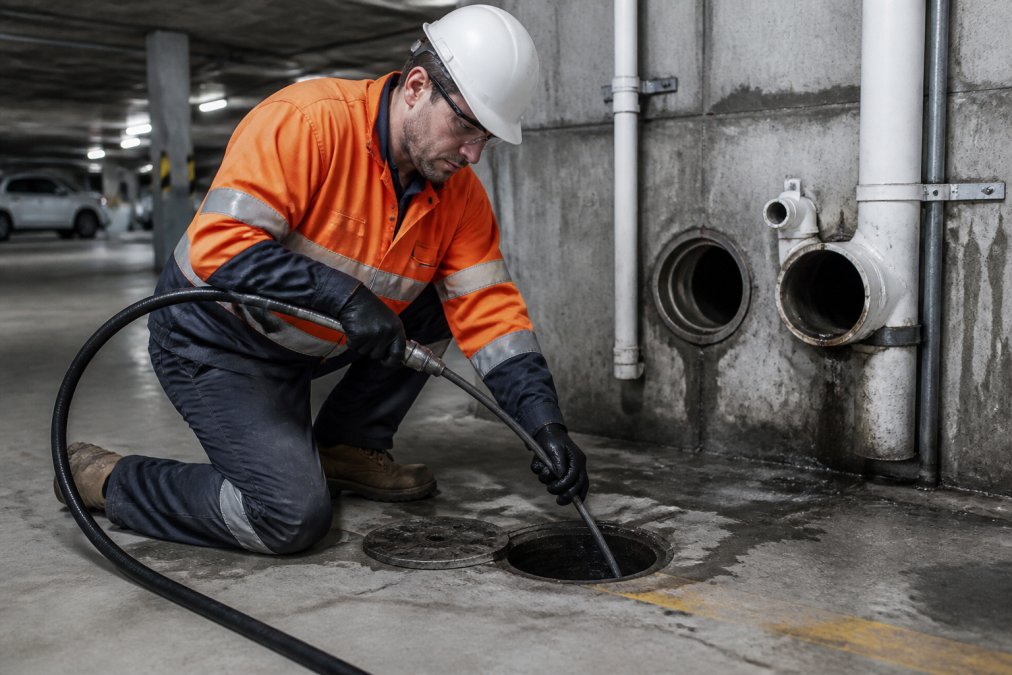
Root intrusion is the most common cause of recurring blockages in established complexes. Tree roots enter through joint gaps and hairline cracks, then expand. Pipe relining seals those entry points from inside the pipe without excavation, which suits strata buildings where digging up common areas is impractical.
Schedule CCTV inspection immediately after every hydro-jetting service on older pipework. The footage proves the line is clear and flags cracks or root entry points before they become failures. It also gives your insurer a dated record.
Eco-friendly maintenance matters here too. High-pressure water and mechanical cutting avoid the corrosive chemicals that damage older pipework and disrupt the treatment processes at wastewater facilities. For strata schemes with environmental commitments, hydro-jetting and relining are the defensible choices.
Emergency Response and Legal Requirements for Strata Plumbing
Only a licensed plumber may carry out drainage work on strata property (fairtrading.nsw.gov.au). In practice, that means a plumber holding the relevant state or territory plumbing licence, with current insurance and a demonstrated understanding of the Plumbing Code of Australia and AS/NZS 3500. Licensing requirements exist to protect the building’s plumbing infrastructure and to keep the work insurable.
Committees should confirm licensing and insurance before any contractor starts work. A licensed plumber will issue a certificate of compliance for drainage work, which the strata corporation needs for its records and for any future insurance claim (qbcc.qld.gov.au). Without that certificate, the corporation may be exposed if the work later fails or causes damage.
What to Verify Before Engaging a Drainage Contractor
- Current plumbing licence number, verifiable through the relevant state or territory licensing authority
- Public liability insurance and workers compensation coverage
- Experience with strata and commercial drainage, not just residential
- Ability to provide CCTV footage and a written report after inspection
- A clear process for issuing compliance certificates
Setting Up an Emergency Response Arrangement
Emergency call-out arrangements deserve a place in the building’s maintenance contract. Sewage backing into a ground-floor tenancy at 2am needs a response within the hour, not the next business day. A pre-arranged agreement should specify:
- Response time targets for after-hours call-outs
- The hourly rate and any after-hours loading, agreed in advance
- Whether the contractor can authorise work up to a set limit without committee approval
- The escalation path if the blockage cannot be cleared on the first visit
- How the contractor will document the work for the maintenance log
Drains Plus operates 24/7 with a no-clear, no-fee guarantee, so committees know the call-out carries no financial risk if the blockage cannot be cleared.
Backflow Prevention and Hydrostatic Testing
Backflow prevention and hydrostatic testing round out the compliance picture. Backflow prevention devices stop contaminated water from flowing back into the potable supply, and they are a standard requirement for commercial and multi-residential drainage systems. These devices need annual testing by a licensed plumber, and the results should be recorded in the maintenance log.
Hydrostatic testing involves filling a section of pipe with water to check for leaks and structural integrity. It is commonly used after relining or before accepting a new drainage installation. Both backflow testing and hydrostatic testing should appear in the annual audit, and both generate documentation that supports the building’s compliance position.
Do not authorise emergency drainage work without confirming the contractor’s licence and insurance, even at 2am. An unlicensed contractor may clear the blockage, but the corporation has no compliance certificate, no insurance cover for the work, and no recourse if the pipe fails later.
Long-Term Asset Management and Insurance Documentation
Drainage infrastructure is a depreciating asset, and strata committees that treat it as one save money over the building’s life. A ten-year asset management plan should map the age, condition and expected remaining life of every major drainage component.
The plan feeds directly into insurance. When a pipe fails and causes water ingress or structural damage, the insurer will ask for maintenance records. A documented history of scheduled inspections, hydro-jetting and CCTV footage supports the claim. A blank file invites a dispute.
Committees should retain:
- CCTV footage and reports from every inspection, dated and filed
- Hydro-jetting and debris removal records
- The maintenance log, including who attended and what was found
- Photos of any water ingress or structural damage before repairs begin
The best drain maintenance for strata properties is documented maintenance. Records turn a routine clear into evidence, and evidence is what protects the maintenance fund when something fails.
Conclusion
Strata drainage problems are predictable, and the buildings that manage them well are the ones with a schedule, a licensed plumber on call, and a paper trail. Reactive repairs cost more, disrupt residents and weaken your insurance position.
Drains Plus has cleared more than 20,000 drains over 25 years, using CCTV inspection and non-invasive methods like hydro-jetting and pipe relining to resolve blockages without excavation. Every job includes a free plumbing health check, and our no-clear, no-fee guarantee means you pay nothing if we cannot clear the line.
Get started with Drains Plus and put a preventative maintenance schedule in place before the next blockage finds you.
Frequently Asked Questions
Who is responsible for blocked drains in a strata scheme?
The strata corporation typically handles blockages in common property pipes, such as shared sewer lines and stormwater drainage. Blocked drains within a lot, like a kitchen sink or toilet, usually fall to the unit owner or tenant. Check your strata by-laws and the strata committee’s guidance. If the cause is root intrusion in a shared line, the strata corporation usually covers repairs. A licensed plumber can confirm the blockage location with a CCTV inspection.
How often should strata properties schedule professional drain cleaning?
Most strata properties benefit from professional drain cleaning every six to twelve months. High-use buildings with commercial kitchens or large landscaped areas may need quarterly servicing. A strata plumbing maintenance schedule should include annual CCTV inspections, hydro-jetting of main lines, and grease trap maintenance where applicable. Regular servicing prevents emergency call-outs and extends the life of your plumbing infrastructure.
What are the common signs your commercial property needs drain cleaning?
Watch for slow-draining fixtures, recurring blockages, unpleasant odours, gurgling sounds, and surface water ponding near drains. In commercial settings, multiple units backing up at once or water ingress in basements are strong indicators. If your maintenance log shows repeated emergency call-outs, it is time for a drainage system audit. Addressing these signs early avoids structural damage and costly repairs.
Can non-invasive methods handle tree roots in strata pipes?
Yes, in many cases. Hydro-jetting cuts through root intrusion, and CCTV inspection confirms the extent of the problem. Pipe relining can seal cracks and prevent regrowth without excavation. However, severe root damage may require a licensed plumber to assess whether relining or traditional repair is needed. Non-invasive solutions are often faster and less disruptive for strata properties.