
Table of Contents
- Signs You Have a Blocked Drain (And What They Mean)
- How Modern Drain Clearing Technology Actually Works
- Sewer Camera Inspection vs Hydro Jetting: Which Comes First?
- Benefits of High-Pressure Water Jetting for Stubborn Blockages
- Chemical vs Mechanical Clearing: Environmental Impact and Pipe Health
- The Cost of Professional Drain Clearing Services Explained
- Matching Drain Clearing Technology to Your Pipe Material
- Preventative Maintenance and Long-Term Pipe Health Monitoring
- Frequently Asked Questions
Last Updated: September 11, 2026
Signs You Have a Blocked Drain (And What They Mean)
Slow-draining water is the first sign most homeowners notice, but it rarely appears alone. By the time a sink or shower backs up, the blockage has usually been building for weeks.
Drain clearing technology for blocked pipes exists because blockages rarely announce themselves early. Water pooling around a floor waste, gurgling sounds from a second fixture, or a faint odour near the drain all point to the same problem: something is restricting flow inside the pipe.
Here’s what each sign typically means:
- Multiple fixtures backing up at once: the blockage sits in the main sewer line, not a single branch drain
- One slow drain, others fine: the obstruction is local to that fixture’s trap or branch
- Gurgling after flushing: air is being pulled through a partial blockage, a common early warning
- Foul odours near drains: waste is sitting and decomposing behind an obstruction
- Water rising in the shower when the toilet flushes: a strong indicator of a main line blockage
A common mistake is treating a recurring slow drain as normal. It isn’t. It means the pipe has narrowed, and it will keep narrowing until water stops moving altogether.
How Modern Drain Clearing Technology Actually Works
Modern drain clearing technology falls into two broad categories: mechanical clearing, which physically breaks up or pulls out the obstruction, and hydro jetting, which scours the pipe interior with water at high pressure.
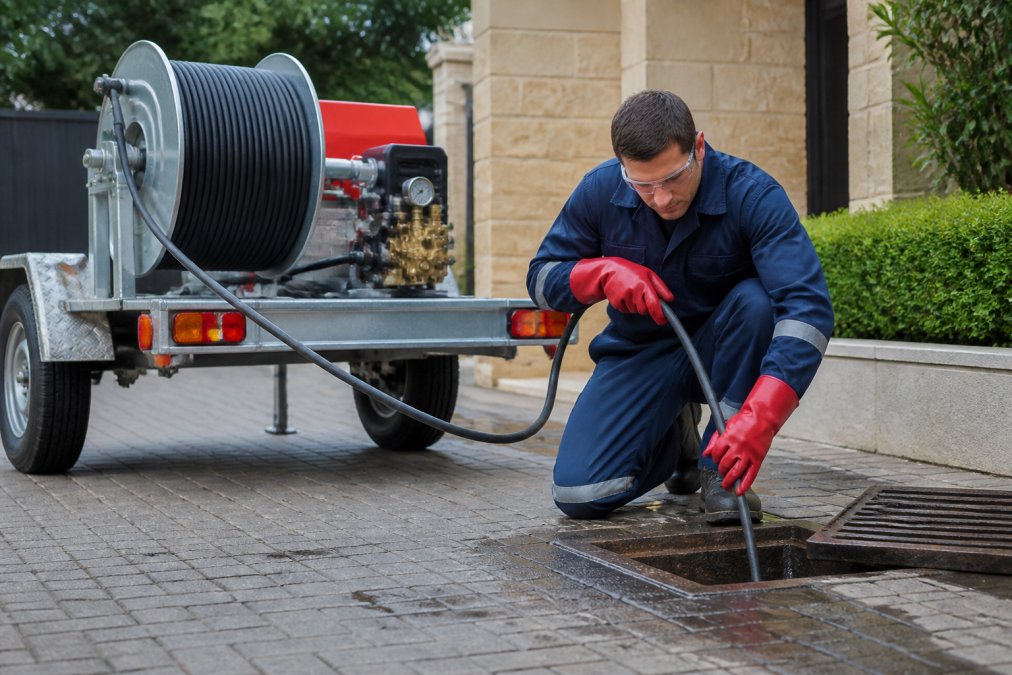
Most professional jobs start with diagnosis, not clearing. A technician needs to know what is blocking the pipe and where before choosing a method.
Mechanical Clearing: Drain Augers and Plumber’s Snakes
A drain auger is a flexible cable fed into the pipe and rotated to break up or hook the blockage. A plumber’s snake is the smaller, hand-operated version of the same principle.
Mechanical clearing works well for:
- Soft blockages like hair, soap scum, and paper
- Blockages close to the drain opening
- Situations where water use cannot be paused for long
The limitation is real. Augers punch a hole through a blockage rather than removing it. Grease and scale clinging to the pipe walls stay put, and the blockage often returns within weeks.
Hydro Jetting and High-Pressure Water Jetters
A high-pressure water jetter forces water through the pipe at high PSI, using a rear-facing nozzle to pull itself forward while scouring the walls clean.
Unlike an auger, hydro jetting removes the entire obstruction and the buildup around it. That is why it handles grease, scale, and root intrusion more reliably than mechanical clearing alone.
Ask what PSI rating the jetter runs at before booking. Jetters that are too powerful for older or fragile pipes can cause damage, so the correct pressure depends on your pipe material, not on “more is better.”
Sewer Camera Inspection vs Hydro Jetting: Which Comes First?
CCTV inspection comes first. A sewer camera inspection identifies what and where the blockage is, while hydro jetting removes it. Skipping the inspection means clearing blind, which risks damaging the pipe or missing a bigger problem.
The sequence matters because the two tools answer different questions. CCTV inspection provides blockage diagnosis and pipe integrity assessment. Hydro jetting provides clog removal.
| Stage | Tool | Purpose | Typical Order |
|---|---|---|---|
| 1 | CCTV drain camera | Locate and identify the blockage | First |
| 2 | Drain auger or snake | Break up accessible soft blockages | If needed |
| 3 | High-pressure water jetter | Scour the full pipe interior | After diagnosis |
| 4 | CCTV re-inspection | Confirm the pipe is clear and intact | Last |
A camera also reveals root intrusion, cracked joints, and collapsed sections that no amount of jetting will fix. If the pipe itself is failing, clearing it is a temporary measure until pipe relining or replacement is considered.
Benefits of High-Pressure Water Jetting for Stubborn Blockages
The benefits of high-pressure water jetting come down to one thing: it cleans the pipe rather than just reopening it. Grease, scale, and root hairs are stripped from the walls, not pushed aside.
For commercial kitchens and restaurants, that difference is operational. A drain that is only punched through will back up again during service. A drain that has been scoured clean buys months, not days.
Hydro jetting also reaches further than mechanical tools. A jetter hose can travel deep into a sewer pipe and around bends that an auger cannot negotiate. Wastewater drainage flows freely again once the pipe interior is clear.
Where it falls short: jetting alone cannot repair a broken pipe, and it should not be used on certain older or damaged materials without assessment first.
Chemical vs Mechanical Clearing: Environmental Impact and Pipe Health
Mechanical clearing is the safer choice for both your pipes and the environment. Chemical drain cleaners rely on caustic or acidic compounds that generate heat, and that heat is what damages pipe walls over repeated use (PubMed).
The environmental angle is often overlooked. Chemical cleaners enter the wastewater system after use, and many municipal treatment processes are not designed to neutralise them. Mechanical clearing and hydro jetting use water and physical force instead, with no chemical residue entering drainage infrastructure.
On pipe health, the pattern is consistent. Chemical drain openers work on soft, close blockages. They do nothing for root intrusion, and they can corrode older pipe materials. Mechanical clearing and hydro jetting handle a wider range of blockages without the same chemical risk.
Pouring chemical cleaner into a fully blocked drain can leave caustic liquid sitting in the pipe, where it attacks the pipe wall and can splash back when the blockage finally gives way. If a drain is completely blocked, call a professional rather than adding chemicals.
The Cost of Professional Drain Clearing Services Explained
Most providers price drain clearing in one of three ways: a fixed call-out fee plus an hourly rate, a flat rate per job type, or a per-metre rate for jetting and CCTV work. Understanding which model you are being quoted under is the difference between a fair price and an unpleasant surprise.
A typical residential call-out fee covers the first 30 to 60 minutes on site (accc.gov.au). After that, most plumbers charge an hourly rate that varies by region and time of day. Hydro jetting is often priced per metre of pipe cleared, because the hose travel and water volume scale with distance. CCTV inspection is usually a separate line item, though some providers bundle it into a jetting quote.
The main cost drivers are:
- Access: a floor waste in a laundry is quick to reach; a buried sewer line under a concrete slab or established garden requires excavation or a different entry point, which adds labour
- Method: a hand auger job might take 30 minutes; full hydro jetting of a main line can take two hours or more
- Diagnostics: CCTV inspection adds time and equipment but prevents repeat call-outs by confirming the pipe is actually clear
- Severity: grease and soap scum clear quickly; root intrusion, scale, and collapsed sections require more passes and may need a follow-up visit
- Timing: after-hours, weekend, and public holiday call-outs typically carry a 50% to 100% premium over standard rates
- Pipe material and condition: fragile clay or corroded cast iron requires lower pressure and slower work, which increases labour time
A common pattern is for the cheapest quote to exclude CCTV inspection and jetting, then add them once the auger fails. The final invoice can end up higher than a quote that included diagnosis from the start. Ask upfront whether the price includes a camera inspection, what the hourly rate is after the first hour, and whether there is a per-metre charge for jetting.
Before booking, ask three questions: Is CCTV inspection included? What is the hourly rate after the call-out fee? Is there a per-metre charge for jetting? The answers tell you more about the final cost than the headline quote.
For consumer guidance on quotes, contracts, and your rights when engaging a tradesperson, the Australian Competition and Consumer Commission’s guidance on service quotes and contracts is worth reading before you book any trade.
If you are comparing providers, ask what happens if the drain cannot be cleared. A no-clear, no-fee policy removes the risk of paying for a call-out that solves nothing, and it aligns the provider’s incentive with actually fixing the problem rather than just attending.
Matching Drain Clearing Technology to Your Pipe Material
Pipe material determines which clearing method is safe, and the reason comes down to how each material fails. PVC flexes under pressure and cracks when the force exceeds its tensile strength. Clay is brittle and fractures along existing cracks or joint lines. Cast iron corrodes from the inside, leaving a thin wall that can shatter under an aggressive auger. Copper is soft and deforms rather than cracking, but caustic chemicals accelerate its corrosion.
That is why the same jetter pressure that cleans a PVC sewer line can destroy a clay one. The pressure is not the problem by itself; the problem is the pipe’s ability to absorb it.
| Pipe Material | Best Clearing Method | Avoid | Why |
|---|---|---|---|
| PVC | Hydro jetting, auger | Excessive PSI | Durable but can crack under extreme pressure |
| Cast iron | Hydro jetting at moderate PSI | Aggressive augers | Old joints are brittle and prone to cracking |
| Clay (older sewer lines) | CCTV first, then low-pressure jetting | High-pressure jetting | Root intrusion is common; walls are fragile |
| Concrete | Hydro jetting | Mechanical cutting tools | Hard but can chip and worsen joint damage |
| Copper | Gentle mechanical clearing | Caustic chemicals | Chemicals accelerate corrosion |
A common pattern is for a pipe to look clear on the day of clearing and fail within months. That usually means the wrong method was used for the material, or the pipe had pre-existing damage that was not assessed first. CCTV inspection before jetting is the only reliable way to confirm wall thickness, joint condition, and whether root intrusion has already opened a fracture.
Never let a provider jet a clay or corroded cast iron line without a CCTV inspection first. The camera shows whether the pipe can withstand pressure, and it costs far less than repairing a collapsed section.
For pipes with recurring root intrusion, trenchless technology such as pipe relining addresses the cause rather than the symptom, sealing the pipe from the inside without excavation. Relining is typically considered when CCTV shows repeated root entry at the same joints, or when the pipe has lost structural integrity but is not yet collapsed. It is not a substitute for clearing, but it changes the maintenance cycle from reactive call-outs to a planned repair.
The practical takeaway is that pipe material should be identified before any clearing method is chosen. If you do not know what your sewer line is made of, a CCTV inspection is the first step, not the last.
Preventative Maintenance and Long-Term Pipe Health Monitoring
Preventative maintenance costs a fraction of emergency clearing and avoids the disruption that comes with a failed drain. The approach is straightforward: inspect before problems escalate.
A practical maintenance routine looks like this:
- Book a CCTV inspection annually for older properties or commercial kitchens
- Keep grease, oil, and food waste out of kitchen drains
- Fit strainers to showers and sinks to catch hair and debris
- Flush drains with hot water weekly to slow grease buildup
- Act on slow drainage immediately rather than waiting for a full blockage
Long-term pipe health monitoring is the gap most property managers miss. A single CCTV inspection after clearing gives you a baseline. Repeat inspections show whether a pipe is stable or deteriorating, which turns reactive repairs into planned maintenance.
Drains Plus includes a complimentary plumbing health check on every job, which gives commercial property managers a documented record of pipe condition over time.
A blocked drain is rarely a one-off event. It is usually the visible symptom of a pipe that has been narrowing for months, and the method used to clear it determines whether it stays clear. Drains Plus has cleared more than 20,000 drains across 25 years, using CCTV inspection, hydro jetting, and mechanical clearing matched to the pipe in front of us, not a one-size-fits-all approach. With 24/7 availability, a no-clear, no-fee guarantee, and a free plumbing health check on every job, the risk of a repeat blockage drops sharply. Call Drains Plus now to book a diagnostic inspection and get your drainage system flowing properly again.
Frequently Asked Questions
What do plumbers use to clear blocked drains?
Plumbers use a combination of mechanical and water-based tools. Drain augers and plumber’s snakes physically break up soft blockages, while high-pressure water jetters scour pipe walls at up to 4,000 PSI. CCTV cameras confirm the blockage location and pipe condition before and after clearing. For root intrusion, a cutting head on the jetter hose slices through roots without excavation in most cases.
Is hydro jetting safe for all types of residential pipes?
Hydro jetting is safe for most pipes when the operator adjusts pressure to suit the material and condition. Clay or older concrete pipes with existing cracks need lower pressure to avoid further damage. A CCTV inspection before jetting confirms pipe integrity. If the camera reveals significant deterioration, pipe relining may be a better long-term option than repeated clearing.
What is the difference between mechanical snaking and hydro jetting?
Mechanical snaking uses a rotating cable or auger to punch a hole through a blockage, restoring flow but often leaving residue on pipe walls. Hydro jetting uses high-pressure water directed backward from a nozzle to scour the full pipe circumference, removing grease, scale, and debris. Jetting cleans more thoroughly, while snaking suits quick access through smaller inspection openings.
Can drain clearing technology identify tree root intrusion?
Yes. A CCTV drain camera inspection shows root intrusion clearly, including the entry point and the extent of root growth inside the pipe. Once identified, a high-pressure water jetter fitted with a root-cutting nozzle can slice through most roots. If roots have caused structural damage, pipe relining or trenchless repair restores the pipe without digging up the yard.